

In Parts 1–3 of this series, we did three things most “AI agent” conversations avoid:
We defined what an enterprise-grade AI agent actually is: a digital worker with three non-negotiable modules — Mission + Skills + Tasks. Remove any one of the three, and you don’t have a digital worker; you have a demo program.
We unpacked why most agents end up as geek toys, and gave you a non-technical checklist to spot them before you waste budget.
We set six admission thresholds and a three-stage rollout framework (Mission → Skills → Tasks), then validated it with a real Odoo Accounts Payable (AP) scenario.
And then the most common question from decision makers landed on the table:
“If AI agents can plan, call tools, and execute workflows… are ERP/CRM systems still necessary? Are agents going to replace ERP/CRM?”
Here’s the conclusion upfront:
ERP/CRM and other enterprise apps are the operational foundation that lets enterprise agents stop being ‘geek toys’ and become real productivity.
Enterprise agents and ERP/CRM are not substitutes. They’re a symbiotic pair:
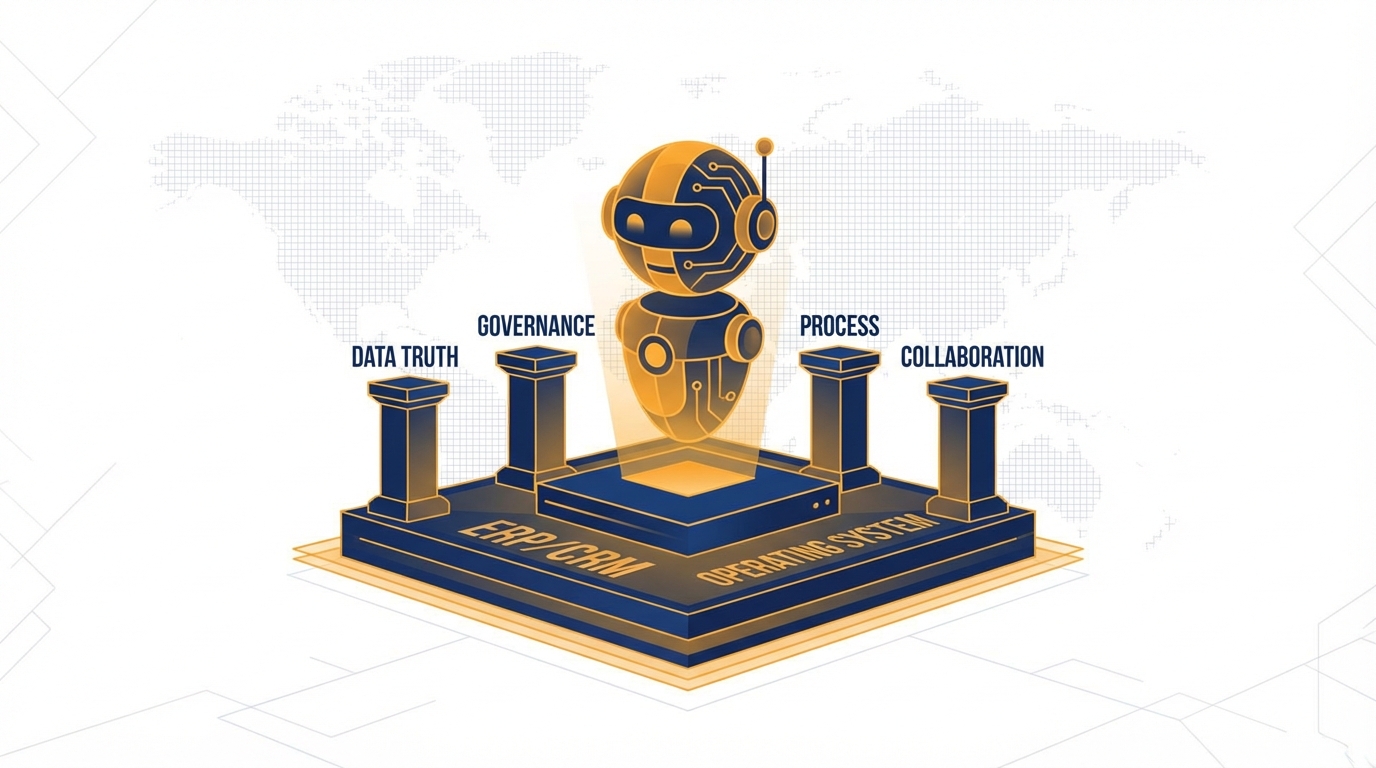
ERP/CRM is the business operating system — the enterprise’s source of truth for data, permissions, compliance, and standard processes.
Enterprise agents are digital workers — they execute tasks inside that operating system, under its rules, with auditable traces.
A “standalone agent” outside your enterprise apps may look great in a demo. In production, it’s usually either a document/chat assistant, or an ungoverned executor you can’t audit.
Neither is enterprise-grade.
Module 2 — Core argument #1: Why enterprise AI agents ERP integration depends on ERP/CRM
Part 2 of this series showed why agents become toys. Part 3 defined the admission thresholds that separate “works on stage” from “works in a company.”
ERP/CRM is not a legacy artifact you keep out of habit. It is the infrastructure that makes those thresholds achievable.
Below are four non-negotiable reasons ERP/CRM remains irreplaceable — and why any narrative about “agents replacing ERP” collapses under operational scrutiny.
1) ERP/CRM is the only authoritative business-data foundation
One of the most common geek-toy patterns from Part 2 was simple: the agent doesn’t have a stable truth source.
It reads whatever you hand it — a PDF here, a spreadsheet there, someone’s email thread — and then confidently produces outputs that look coherent but aren’t grounded in a consistent data model.
That’s exactly why Part 3 introduced the admission threshold of business-context adaptation. An enterprise agent must understand:
what a “customer” means in your company,
which entity is the legal seller of record,
what “approved” means in your approval chain,
which record overrides which, and
what counts as “final truth” when data conflicts.
ERP/CRM is where that truth hierarchy is encoded.
Take a very practical example in Odoo AP — the scenario we validated in Part 3, and the most common starting point for AI agents for Odoo ERP accounts payable:
Your master data (vendors, accounts, tax rules) has a higher truth level than a one-off document.
A purchase order carries contractual intent.
A vendor bill carries legal and accounting impact.
In many companies, the data truth order is effectively:
Vendor master / chart of accounts > purchase order > vendor bill > email attachment
An agent that doesn’t anchor to that truth hierarchy can’t safely decide what to post, what to reject, and what to escalate.
So when someone says, “Agents will replace ERP,” ask one question:
Where is the authoritative data model that the agent will treat as truth — and how is truth resolved when sources conflict?
If the answer is “the agent will figure it out,” you’re looking at a toy.
2) ERP/CRM is the native carrier of compliance, permissions, and auditability
Part 2 also exposed a second toy pattern: permissions are treated as a feature.
In reality, permissions are not a feature. They are the governance skeleton of a company.
Part 3’s security and governance threshold exists for a reason:
A usable agent must respect role boundaries.
It must operate under least-privilege.
It must trigger the same approvals a human would trigger.
It must leave a complete audit trail.
ERP/CRM already contains:
role-based access control (RBAC),
approval workflows,
segregation of duties,
financial period controls,
record-level logging,
and the compliance logic that auditors and regulators expect.
A standalone agent can bolt on permission checks, but it can’t reliably recreate the governance reality that already exists in your ERP/CRM.
Because enterprise governance isn’t just “who can click a button.” It’s the whole control system:
who can create vs. approve vs. pay,
which approvals are required above a threshold,
which exceptions must be documented,
and what evidence is required for audit.
If an agent isn’t deeply integrated with ERP/CRM, you inevitably get one of two outcomes:
Over-restricted agents (they can’t do anything meaningful), or
Overpowered agents (they can do too much, with too little traceability).
Either way, you fail the enterprise admission threshold.
3) ERP/CRM is the execution framework for standardized processes
In Part 1, we said a real enterprise agent needs Tasks, not just “capabilities.”
Tasks are what make value measurable:
a defined input
a defined output
a defined SLA
and an auditable execution trace
Those task definitions don’t appear out of thin air. They come from your standardized business processes.
And where do those processes live?
They are encoded in ERP/CRM:
procurement → receiving → billing → approval → payment
sales → delivery → invoicing → collection
CRM qualification → pipeline stages → handoff to fulfillment
These aren’t just workflows; they are company policy expressed as systems.
This is why the “agents replace ERP” framing is backwards.
ERP/CRM is not the thing agents must replace. It is the thing agents must inherit:
inherit your baseline process
inherit your exception rules
inherit your compliance gates
Then, inside that framework, the agent creates leverage:
automating repetitive steps
catching inconsistencies early
routing exceptions correctly
and shrinking cycle time without breaking controls
A common failure mode is trying to “rebuild the process in the agent.”
That creates a shadow ERP.
Shadow ERPs are where governance goes to die.
4) ERP/CRM is the collaboration hub that makes scale possible
Part 3 ended with a preview: cross-region rollout is where most “successful pilots” collapse.
In cross-border SMEs and growth companies, “one workflow” is never just one workflow.
It’s:
multiple legal entities,
multiple tax regimes,
multiple approval chains,
multiple currencies,
and multiple operational teams.
ERP/CRM is where that complexity is managed at scale:
multi-company configuration
shared master data with controlled variance
cross-department coordination
consolidated reporting
That’s why ERP/CRM is the only realistic scale pathway for enterprise agents.
Without ERP/CRM as the hub, agents remain:
single-scenario demos
localized automations
fragile scripts that break when the organization changes
With ERP/CRM as the hub, agents can become:
reusable, governed digital workers
deployable across entities and regions
measurable as a portfolio (not a collection of hacks)
Key Takeaway: ERP/CRM is not what you “integrate later.” It is the foundation that makes enterprise agent admission thresholds achievable.
Hook to Part 5: These four non-replaceable dimensions apply across company sizes and industries. What changes is the ERP/CRM choice, process complexity, and compliance depth — and therefore the integration pattern for agents. In Part 5, we’ll break down how this adapts for SMEs and sector-specific workflows.
Module 3 — Core argument #2: Enterprise agents and ERP/CRM are a symbiotic system
To end the confusion, we need a clean mental model.
The base layer: ERP/CRM is the business operating system
ERP/CRM isn’t just a database or workflow tool. In practice, it’s the enterprise’s semantic layer — its ontology: the shared definitions of what things are (customer, vendor, invoice, approval), and how they relate (who owns what, what overrides what, what must be validated).
That semantic layer is what makes ERP/CRM the business operating system. It carries the “physics” of your business:
the canonical data model and object relationships
the process baseline and exception rules
permissions, approvals, and segregation of duties
compliance constraints and audit evidence
That’s what an operating system does: it defines what is true, what is permitted, and what is observable.
The execution layer: Enterprise agents are digital workers running on that OS
In Part 1, we defined an enterprise agent as a digital worker with:
Mission: what it’s trying to achieve, with boundaries
Skills: what it can do reliably
Tasks: the standardized units of work it executes
Now anchor each layer to enterprise apps.
Mission layer: The agent’s mission is 100% anchored to ERP/CRM goals and red lines
If the mission is generic — “help finance,” “improve efficiency,” “handle invoices” — you will drift into toy territory.
In an enterprise, mission must be tied to:
the actual workflow target (e.g., vendor bill posting, 3-way match, payment proposal)
the approved business objective (reduce cycle time, reduce errors, increase compliance)
the compliance red lines (GDPR, local e-invoicing mandates, data residency)
and the authority boundaries embedded in ERP roles
In other words: mission is not invented; it is inherited.
Example, continuing the Odoo AP thread from Part 3:
Mission is not “process invoices faster.”
Mission is “post vendor bills in Odoo within policy, enforce approval thresholds, and prevent non-compliant entries — while reducing manual touch.”
That mission is only meaningful because Odoo already defines:
what “posted” means
what approvals are required
what fields are mandatory
and what constitutes an exception
Skills layer: The agent’s core skills are native ERP/CRM operations
A common misconception is treating skills as independent “agent powers.”
But in enterprise reality, skills only matter if they can execute inside your operating system.
For enterprise apps, the highest-value skills are:
native integration (API when available; controlled UI automation when APIs aren’t viable)
structured data handling aligned to the ERP schema
exception routing that mirrors approval and ownership
reconciliation behaviors that match your accounting logic
If a skill cannot land safely inside ERP/CRM constraints, it’s usually a demo trick.
Continuing the AP example:
Dual-mode data capture (documents + system signals)
ERP-native posting and validation
Exception and dispute routing
Those skills are valuable because they show up as:
posted bills
reconciled payments
tracked exceptions
audit-ready traces
Not because the agent can “understand invoices.”
Task layer: Tasks are cloned from ERP/CRM standard workflows
Tasks are where enterprise agents either become production systems — or die as toys.
A task is not “handle AP.”
A task is:
“Create draft vendor bill from captured invoice + PO context”
“Validate tax and vendor master alignment”
“Route for approval above threshold”
“Post bill and log evidence”
Each task has:
a defined input
a defined output
an error-handling pattern
a rollback plan
and an audit trace
And the blueprint is already inside ERP/CRM.
This is the core correction:
Agents don’t replace ERP/CRM tasks. They execute ERP/CRM tasks faster, more consistently, and with better exception handling — under the same governance model.
Hook to Part 5: This symbiosis logic is universal. The difference is how SMEs and specific sectors package it: lighter ERP/CRM configurations, smaller teams, and “out-of-the-box” workflows. Part 5 will show how to adapt the same logic to SME constraints and vertical workflows.
Module 5 — Cross-region benchmark: three anonymized composite cases
The goal of these cases is not to sell a vendor story. It’s to show what “anchored to ERP/CRM” looks like under real constraints.
All three cases below are anonymized composites based on common patterns in cross-border SMEs and growth companies. They are intentionally written in a way you can map to your own environment.
Case A (EU): GDPR-first Odoo AP agent for vendor bill processing
Company profile
EU-based operations with suppliers across multiple countries.
200–800 employees, finance team under pressure during month-end.
Core system: Odoo Accounting + Purchases.
Pain point
Vendor bills arrive via mixed channels.
Data contains personal information in attachments (GDPR exposure).
Manual posting creates inconsistent classification and late approvals.
ERP choice & why it matters
Odoo holds vendor master data, approval thresholds, and accounting rules.
GDPR compliance is not “a policy doc”; it’s enforced through access roles, controlled exports, and auditable handling.
Agent + ERP integration approach
The agent operates inside Odoo’s workflow boundaries:
drafts bills
suggests coding
routes approvals
never posts outside permitted roles
3-stage adaptation
Mission: “Reduce AP cycle time while enforcing Odoo approval and GDPR handling rules.”
Skills: invoice capture + Odoo record creation + exception routing to AP owner.
Tasks: create draft bill → validate vendor + PO → route approval → post bill → attach evidence.
Implementation timeline
Phase 1 (pilot): one business unit, one vendor group.
Phase 2 (scale): add multi-company rules and localized approval thresholds.
KPIs measured (categories, not fabricated numbers)
invoice-to-post cycle time
% bills requiring rework
approval latency by threshold
audit exceptions per month
Governance model
RBAC mirrored from Odoo roles.
Sensitive attachment handling: minimized access; controlled export; auditable traces.
Conclusion
GDPR compliance didn’t block automation — it shaped it. The agent worked because it was anchored to the ERP truth and governance.
Case B (LATAM): Odoo invoicing agent under CFDI/NF-e compliance pressure
(If you’re searching for an architecture pattern, this section maps to the intent behind queries like e-invoicing compliance automation GDPR CFDI NF-e — the key is that compliance is enforced at the ERP record and workflow layer, not in free-form chat.)
Company profile
LATAM expansion with Mexico and Brazil entities.
50–300 employees per entity; thin local finance coverage.
Core system: Odoo Invoicing + Accounting.
Pain point
Electronic invoicing mandates require structured outputs and validations.
Manual handling leads to rejects, rework, and delayed shipments.
ERP choice & why it matters
Odoo acts as the operational ledger and the source of transactional truth.
Compliance is enforced through structured invoice data and approvals.
Agent + ERP integration approach
The agent does not attempt to “be the tax authority connector” by itself.
It anchors on ERP records and focuses on:
data completeness
validation readiness
exception routing
controlled submission steps with traceability
3-stage adaptation
Mission: “Ensure invoices created in Odoo are compliant-ready before submission; reduce rejection loops.”
Skills: data extraction from orders → structured field validation → exception classification → rework routing.
Tasks: pre-check invoice → validate mandatory fields → validate customer master → route exceptions → approve for submission.
Implementation timeline
Start with one entity (Mexico or Brazil), one invoice type.
Expand to multi-entity with controlled variance.
KPIs measured (categories)
rejection rate
time-to-correct rejected invoice
days sales outstanding (DSO) impact
compliance incident count
Governance model
Approval gates remain native to ERP workflow.
Any “submission” action requires traceable approval.
Conclusion
In LATAM, the agent’s value is not replacing the compliance system. It’s preventing bad transactions from entering the compliance funnel.
Case C (SEA): multi-store inventory + AP matching agent for Odoo retail operations
Company profile
Multi-store operations across SEA with uneven connectivity.
100–1,500 employees; high SKU churn.
Core system: Odoo Inventory + Purchases + Accounting.
Pain point
Inventory mismatches create procurement noise.
Vendor bills don’t align with goods receipts.
Store teams and central finance lose time reconciling.
ERP choice & why it matters
Odoo holds the cross-store stock truth, purchase receipts, and vendor bill links.
Multi-store collaboration is a system problem, not a chat problem.
Agent + ERP integration approach
The agent works as a reconciler inside the ERP:
flags mismatch patterns
suggests corrective actions
routes to store ops vs central finance based on ownership
3-stage adaptation
Mission: “Reduce inventory and AP reconciliation workload without breaking store autonomy and approval rules.”
Skills: receipt vs bill matching, anomaly detection, task routing.
Tasks: daily mismatch scan → classify → assign owner → propose correction → confirm and log.
Implementation timeline
Pilot with one region + a subset of stores.
Scale by templating tasks and ownership rules.
KPIs measured (categories)
mismatch rate
time-to-resolve mismatch
% AP holds due to inventory issues
stock accuracy improvement
Governance model
Store actions and central finance actions remain separated by role.
All proposed corrections require confirmation in ERP.
Conclusion
Scale came from ERP standardization plus agent execution — not from adding “smarter prompts.”
Module 6 — Why vertical, ERP-anchored agents can’t be replaced by general agents
General agents are good at:
broad Q&A
summarizing documents
calling a few tools for light workflows
They are not built for:
deep ERP-native integration
organization-specific process rules
cross-region compliance variance
auditable execution under least privilege
This is the core moat of vertical enterprise agents:
They don’t just “understand.” They operate — under the same controls your auditors and regulators already accept.
So the real strategic question isn’t:
“Which general agent is smartest?”
It’s:
“Which enterprise agents can safely execute inside our ERP/CRM operating system, at scale, under governance — with a real audit trail?”
That’s the practical meaning of enterprise agents ERP CRM symbiosis: the system defines truth and controls; the digital worker executes repeatable tasks inside those controls.
And it’s why teams evaluating AI agents governance role-based access audit trail as a checklist item almost always end up back at the same place: the controls already live in the ERP/CRM, so the agent must inherit them rather than reinvent them.
Hook to Part 5: This advantage is even more pronounced in SMEs and specific sectors — where teams can’t afford tool sprawl, and workflows are domain-shaped. Part 5 will break down the sector-specific playbooks.
Module 8 — Closing: the only reliable path from geek toy to core productivity
Let’s restate the full logic in one line:
An enterprise agent without ERP/CRM anchoring is a toy — because it has no authoritative truth, no native governance (role-based access, audit trail), no standardized task framework, and no scalable collaboration hub.
To make the relationship explicit in the language most teams search for, this article is about enterprise AI agents ERP integration — not as a connector project, but as an operating model: agents become production-grade only when they inherit ERP/CRM truth, controls, and workflows.
The winning architecture is not “agent vs ERP.”
It’s:
ERP/CRM as the business operating system
enterprise agents as governed digital workers running inside it
Next steps (MOFU)
If you’re evaluating agent adoption right now, run a controlled pilot that forces reality:
pick one workflow already stable in ERP (AP is usually the best start)
define mission boundaries from ERP roles and compliance red lines
implement skills only if they write back into ERP objects and logs
measure cycle time + error rate + exception handling quality
If you want a quick way to avoid toy pilots, use this geek-toy red flags checklist for AI agents as a procurement filter before technical evaluation.
Part 5 preview (Agents for SMEs and Sectors)
This article gave you the universal foundation: why ERP/CRM remains non-replaceable, what the symbiosis is, and how to land agents using Mission–Skills–Tasks anchored to enterprise apps.
In practice, SMEs and different sectors need tailored packaging:
SMEs require lighter ERP/CRM choices, faster rollout, and lower integration overhead.
Retail, restaurants, cross-border e-commerce, and professional services have different “standard workflows” — which changes where you anchor mission, which skills matter, and how you scale across regions.
In Part 5, we’ll focus on Agents for SMEs and Sectors: SME-specific rollout playbooks, vertical benchmark cases, and how the same symbiosis rules adapt to industry workflows — so you can copy a pattern that matches your reality, not a generic demo.