

You asked a fair question after the first two articles: “We understand what makes a valid AI agent, and we know how to spot a toy. Now, how do we actually build and implement a real Enterprise Level Agent that delivers consistent business value?” This guide answers that with a complete, step-by-step implementation framework, the non-negotiable qualification thresholds, a practical pitfall-avoidance playbook, and a real-world case study—so toy-agent failures don’t stand a chance.
Section 1: Six Non‑Negotiable Thresholds for Enterprise Level Agents
Real Enterprise Level Agents aren’t clever demos. They are digital workers embedded in your operating model. Each threshold below directly counters a “geek toy” flaw we identified in Article 2.
1) Business Context Fluency Threshold
Enterprise agents must natively integrate with live, distributed business data across ERP, POS, finance platforms, and team knowledge—and resolve conflicts with a source‑of‑truth hierarchy (e.g., Odoo master data > PO/GRN > supplier bill). For AP on Odoo, that means bidirectional access to vendor bills, POs, receipts, approvals, and bank feeds. In a word, Agents need to understand enterprise data model and are able to manipulate enterprise data and process.
How to verify: In a dry run, deliberately inject conflicting values (tax codes, totals, vendor IDs) and observe whether the agent prioritizes authoritative data and explains its decision path.
2) Rule Embedding Threshold
Tool calls aren’t enough. Enterprise decision rules, approval workflows, compliance guardrails, and exception protocols must be built in, with clear boundaries for automation vs. human‑in‑the‑loop. In AP, that includes three‑way matching, amount‑based approvals, and pre‑posting tax checks tied to region.
How to verify: Inspect the rule catalog. You should see codified approvals and validations that mirror your ERP policies, not ad‑hoc prompts.
3) Exception Handling Threshold
Work doesn’t happen only on the happy path. Your agent must reliably resolve 99% of non‑standard cases: incomplete data, OCR ambiguities, format mismatches, order exceptions, and compliance validation failures—while explaining errors and routing with evidence.
How to verify: Run a seeded exception set (low OCR confidence, unmatched receipts, invalid CFDI fields, NF‑e signature issues) and confirm resolution routes and success rates.
4) Security & Governance Threshold
Execution without governance is a liability. Minimum bar: role‑based access control (RBAC) mapped 1:1 to your ERP roles; strict data access boundaries; and tamper‑proof end‑to‑end audit trails. This aligns with GDPR security expectations and common SOC 2 practices around access enforcement and logging. For control families and practices, see NIST SP 800‑53 Rev. 5 (Final) and the AICPA SOC suite overview.
How to verify: Prove least‑privilege by revoking a permission in Odoo and confirming the agent immediately loses the corresponding action. Export an immutable audit log for an end‑to‑end invoice run and review.
5) Dynamic Adaptability Threshold
Business changes constantly. Agents must be adjustable via conversational, zero‑code controls—new products, updated tax rules, or org restructures—without a prompt‑rewriting marathon.
How to verify: Ask a finance manager (non‑technical) to update an approval threshold and add a new VAT validation rule. Changes should go live with maker‑checker approval and appear in the audit log.
6) Baseline & Iteration Threshold
Enterprises don’t adopt AI into a blank slate. They already run mature systems, roles, controls, and “the way work gets done.” A real Enterprise Level Agent must accept that baseline first—your current ERP workflows, data definitions, approval chains, and compliance gates—then improve outcomes through fast, small, auditable iterations.
That means the agent should propose changes as incremental patches (a new validation rule, a tighter exception route, a revised threshold), not as a sweeping rewrite of your operating model based on its own idea of “optimal.” In practice, you want controlled evolution: preserve what is stable, iterate what is broken, and keep every change reviewable.
How to verify: Take one stable AP flow (e.g., vendor bill posting) as the baseline. Ask the agent to improve one measurable KPI (error rate, cycle time, exception closure) by introducing a single rule or routing tweak. Confirm it can run A/B or staged rollout, record a clear change log, and roll back cleanly if outcomes degrade.
Section 2: Core Implementation Methodology — 3‑Stage Framework Built on Mission–Skill–Task
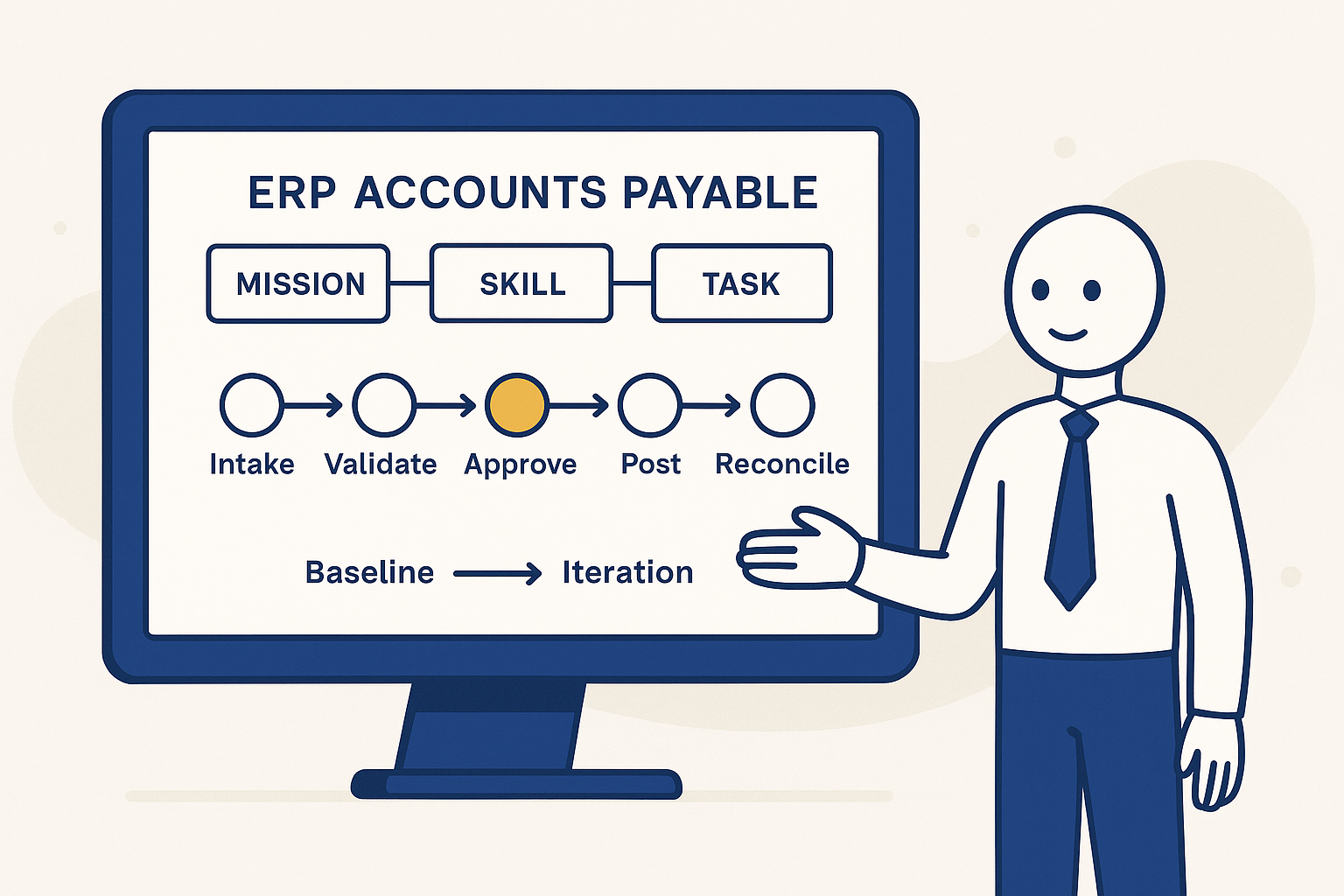
Article 1 defined the pillars—Mission, Skill, Task—as interdependent and non‑negotiable. Here’s how to turn them into an AP‑on‑Odoo implementation that stands up to governance scrutiny and delivers measurable value.
Stage 1: Define the Mission — From Empty Slogans to an Enforceable Enterprise Rule System
Start by locking in a precise, narrow scope. Avoid “finance AI agent.” Specify “Accounts Payable AI Agent for Odoo across EU entities and LATAM suppliers.” Document the lawful basis for processing and complete a DPIA where required, aligning to the GDPR text—see Articles 28, 30, 32, and 35 on EUR‑Lex—and the UK ICO’s guidance on AI and personal data.
Lock the use case. Define exact business outcomes, data domains, systems, and geographies. For Odoo AP: vendor bill intake, validation, approvals, posting, and bank reconciliation. Map how two‑ and three‑way matching will apply. See Odoo’s process references for vendor bills, approvals, and three‑way matching.
Translate compliance into rules. In the EU/UK, embed privacy‑by‑design, access minimization, and logging. In Mexico, ensure CFDI 4.0 mandatory fields (issuer/receiver RFC, regime, name, postal code; ObjetoImp VAT classification) and PAC “timbrado” (UUID issuance) are validated pre‑posting; in Brazil, enforce NF‑e XML signature checks and SEFAZ authorization before payment or recognition. See the SAT portal for CFDI 4.0 standards and catalogs and the NF‑e National Portal documentation for the canonical requirements.
Map permissions 1:1 to ERP roles. Mirror Odoo roles and approval hierarchies to the agent, enforcing least privilege and maker‑checker boundaries. Align to recognized control frameworks such as NIST SP 800‑53 (AC‑2/AC‑3/AC‑6 for RBAC; AU‑2/AU‑6 for logging) and maintain processor obligations per the GDPR (Art. 28) with records of processing (Art. 30).
Define success metrics in business terms. Replace “improve efficiency” with auditable KPIs. For this article’s anchor, optimize for reconciliation cycle time: e.g., reduce from 15 business days to 3 while maintaining <0.1% key‑field error rate and zero compliance violations. Make SLAs explicit: exception routing within 2 hours; compliance failures blocked at source with clear error codes.
Stage 2: Match the Skills — From Feature Bloat to a Closed‑Loop, Use‑Case‑Specific Capability Matrix
Select only the capabilities that execute the mission end‑to‑end, integrated natively with Odoo, and hardened with exception logic.
Keep only mission‑critical skills. For AP on Odoo, three suffice: dual‑mode data capture (file/email drop + scan/OCR), native bidirectional ERP integration, and reconciliation exception routing. Everything else is vanity.
Prioritize native integrations. Use Odoo’s standard AP flows as the backbone: bills, approvals, three‑way match, and bank reconciliation. Synchronize the agent’s permissions with Odoo groups so access changes propagate immediately. Avoid custom overhauls that break upgrades.
Build exception handling into every skill. Set conservative OCR confidence thresholds for vendor ID, totals, tax codes; block CFDI 4.0 mismatches (RFC, catalog codes) and NF‑e signature or SEFAZ authorization failures; route unmatched reconciliation items with supporting evidence. Ensure every route is logged.
Make skills zero‑code configurable. Finance and operations users should adjust thresholds, approval routes, and validation rules conversationally, with tracked maker‑checker approvals and change logs to support SOC‑aligned change management.
Stage 3: Break Down the Tasks — From Vague Work to Repeatable, Quantifiable, Auditable Workflows
Decompose the end‑to‑end AP flow into indivisible, standard tasks with clear inputs/outputs, approvals, and compliance gates.
Define minimum task units. For example: intake → capture/parse → validate (business + compliance) → approval route → ERP post → payment readiness → bank reconciliation → exception closure. Give each node an owner, inputs/outputs, and SLA.
Insert compliance validation at every gate. Only validated items advance. For LATAM suppliers, block posting until CFDI PAC UUID is confirmed and catalog fields match; for Brazil suppliers, verify NF‑e XML signature and SEFAZ authorization; for EU entities, ensure access is least‑privilege and logged.
Enforce tamper‑proof auditability. Log instructions received, data accessed, actions taken, approvals, and final outcomes. Export immutable logs for internal audit and, if relevant, external SOC assessments.
Enable dynamic updates without code. When VAT rates, approval thresholds, or org charts change, a business owner should update rules conversationally, with the system regenerating task configurations and recording the change set.
Section 3: Critical Pitfall Avoidance Guide for Enterprise Implementation
Starting with tech and hoping value shows up is how toy agents are born. Here’s how to avoid the five most common failure modes and route to the enterprise path instead.
Pitfall 1: Building a framework first, then hunting for a use case. The corrective move is to pick a single, standardized, high‑frequency AP scenario—like vendor bill intake to bank reconciliation on Odoo—then apply Mission → Skill → Task in that order. Success scales from specificity.
Pitfall 2: Chasing a company‑wide rollout on day one. Validate a narrow use case with clear value, stabilize it, then replicate across stores, departments, and regions. Treat each new scope as a controlled change with its own readiness checklist and mini‑pilot.
Pitfall 3: Treating compliance and security as add‑ons. Bake GDPR requirements (lawful basis, RoPA, DPIA, Art. 32 security) into mission definition, and enforce RBAC and audit logging from the first task node. For LATAM invoices, never allow posting without PAC timbrado (CFDI) or SEFAZ authorization (NF‑e).
Pitfall 4: Tech‑led development without business ownership. Put finance and operations in the driver’s seat for requirements, rules, and KPIs. Engineering enables; the business defines value and guardrails. This is how you get adoption and accountability.
Pitfall 5: a pilot. Run a 7‑day small‑scale pilot to validate workflow smoothness, exception handling, and KPI movement, then fix gaps before expanding. A quick, controlled test prevents entrenched inefficiencies at scale.
Section 4: Real‑World Implementation Case Study (AIForceX)
Background. A high‑growth retail chain with 12 brick‑and‑mortar stores in Southeast Asia struggled with disorganized inventory signals, high invoicing compliance risk, and manual reconciliation that dragged on for half a month. Several earlier AI tools never integrated cleanly with Odoo, didn’t meet local tax rules, and were too complex—classic “geek toys.”
Three‑Stage Implementation. The team used the Mission–Skill–Task framework to implement an AP agent.
Mission. They locked the scope to “End‑to‑End Accounts Payable & Inventory‑Linked Validation for 12 Stores on Odoo,” embedded regional guardrails (CFDI 4.0 for Mexican suppliers, NF‑e checks for Brazilian suppliers), completed a DPIA for EU/UK entities, and mirrored Odoo permissions 1:1 with least privilege. Success metrics emphasized reconciliation cycle time reduction and zero compliance violations.
Skills. They deployed three capabilities only: dual‑mode invoice/inventory data capture, zero‑code native Odoo integration with permission sync, and automated reconciliation exception routing. For data control, they used an on‑premises desktop deployment model. Business users adjusted rules conversationally with maker‑checker approvals.
Tasks. They standardized seven auditable nodes from intake through reconciliation, inserting compliance validation gates (CFDI PAC UUID checks; NF‑e signature/SEFAZ authorization) before posting. Every action and configuration change wrote to an immutable audit log.
Measurable Results. Over two monthly closes, the finance team measured a reconciliation cycle time cut from 15 business days to 3, while maintaining zero compliance violations and an 85% improvement in invoice posting efficiency. Stockout incidents fell as upstream data quality improved and exceptions were resolved faster. The team attributed the gains to rule‑embedded workflows, ERP‑native permissions, and rigorous exception routing rather than any single AI model feature.
Note on positioning. Enterprise buyers often work with implementation partners to achieve this rigor. Providers like AIForceX can be engaged to support on‑premises deployment, Odoo‑native role mapping, and multi‑region compliance configuration, but the framework above remains vendor‑agnostic and repeatable.
Conclusion — From Toy to Trustworthy Operator, One Use Case at a Time
Enterprise Level Agents are not hobby projects. They’re digital workers integrated into your ERP, approvals, and compliance stack—built on the non‑negotiable Mission–Skill–Task framework. The dividing line between toys and enterprise tools isn’t flashier tech; it’s the ability to solve a specific problem the same way, every day, under governance, with measurable value.
Your next step: This quarter, choose a single high‑frequency AP use case on Odoo. Apply the three stages in order. Embed GDPR and LATAM e‑invoicing guardrails from day one. Run a 7‑day pilot focused on cutting reconciliation cycle time and verifying exception handling. Then scale deliberately.
Coming up next in this series: a deep dive into region‑specific benchmark case studies for Enterprise Level Agent implementations across the EU, Latin America, and Southeast Asia—so you can compare results, timelines, and governance patterns with confidence.